Bulgaria’s power sector is entering a new phase. After several years in which solar development dominated the country’s renewable energy story, attention is now shifting to the infrastructure needed to manage that generation. Battery energy storage is moving quickly from a niche investment category into one of the most closely watched segments of Bulgaria’s energy market.
Battery energy storage is accelerating faster than expected
The numbers explain why the sector is now attracting serious attention. By May 2026, Bulgaria had more than 3.3 GW of installed battery storage capacity, according to data reported by Renewables Now from the European Network of Transmission System Operators for Electricity. That was more than double the level recorded at the start of the year. In 2025 alone, the country added around 2.5 GWh of new battery energy storage system capacity, an increase of roughly 1,100% year on year, placing Bulgaria third in the EU by newly installed volume after Germany and Italy.
The pace is striking for a market that, only a short time ago, was still being described as small by European standards. In 2024, Bulgaria had only tens of megawatt-hours of battery capacity in operation. The rapid change reflects three forces acting at once: a sharp rise in solar power, European funding for standalone storage, and stronger commercial interest in flexible electricity assets.
The most visible policy driver is RESTORE, Bulgaria’s national programme for grid-scale electricity storage financed through the EU Recovery and Resilience Facility. The European Commission says the investment is designed to support 3,000 MWh of usable storage capacity, distributed across the country and located near renewable generation. In practice, the approved project pipeline is much larger. Under the first major round of RESTORE support, 82 standalone projects were approved for about 9.71 GWh of total capacity, backed by roughly EUR 587 million in subsidies.
This does not mean every proposed project will be built on time or perform as expected. Yet the scale of the pipeline has already changed the conversation. Storage is no longer being discussed only as a back-up technology for individual sites. It is increasingly viewed as part of the national electricity architecture.
Renewable energy growth is changing Bulgaria’s energy market
The reason is simple enough, although the economics are complex. Bulgaria’s solar capacity has expanded quickly, supported by merchant projects, power purchase agreements and investor appetite for renewable energy assets. As solar output rises during the day, the electricity system must deal with periods of abundant production, weaker prices and, in some cases, zero or negative wholesale prices. When the sun sets and demand rises, the same system then needs fast, flexible capacity.
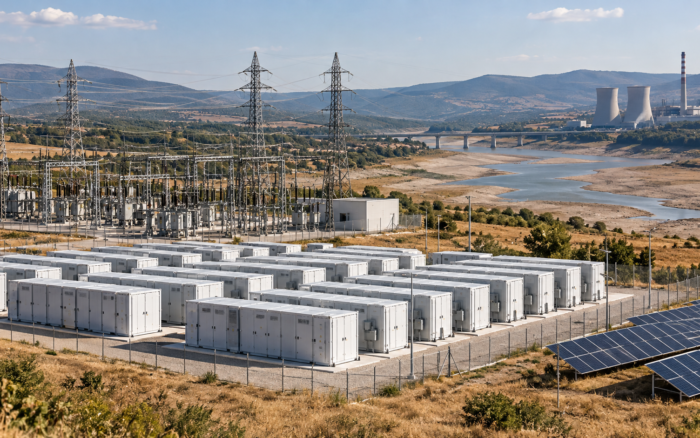
Storage helps bridge that gap. Batteries can absorb electricity when production exceeds demand and release it later, when power is more valuable or when the grid needs support. This gives solar developers a way to reduce curtailment and improve revenue stability. For grid operators, storage can contribute to balancing, frequency response and congestion management. For industrial consumers, it can help smooth demand peaks, improve resilience and reduce exposure to volatile power prices.
The commercial logic is already becoming visible. One of the most notable recent projects is Enery’s 150 MW / 601.8 MWh facility in Nova Zagora, described as the largest operational battery in Central and Eastern Europe. The system is connected to the transmission grid through a new substation and is expected to operate under a virtual power purchase agreement with commodities trader Vitol. Such projects show that Bulgaria’s storage sector is attracting not only developers, but also lenders, traders and corporate offtakers.
Why does energy storage matter to business and investors?
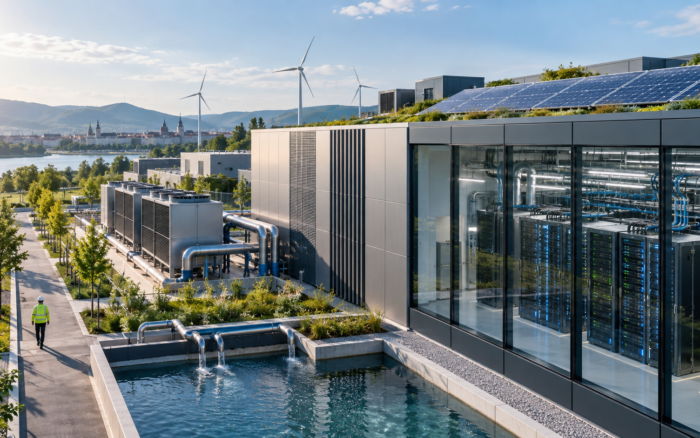
For businesses, the implications go beyond the energy sector itself. Large consumers are beginning to think about electricity less as a fixed operating cost and more as a managed risk. A factory, data centre, logistics hub or commercial estate may combine on-site solar, battery capacity, flexible consumption and a market-facing supply contract. In that model, energy storage becomes part of corporate infrastructure planning rather than a separate technical add-on.
The shift also matters for investors. Storage can create value through wholesale arbitrage, participation in balancing markets and co-location with renewable generation. However, these revenue streams are not guaranteed. As more batteries enter the system, price spreads may narrow. A project that looks profitable under today’s volatility may need a broader strategy in several years, combining trading income, ancillary services and long-term contractual arrangements.
Grid flexibility will determine the next stage of development
There are also technical and regulatory risks. Grid connection capacity remains a central constraint. Some assets may face delays because of permitting, network reinforcement needs or local planning issues. Battery degradation, cycling strategy, warranty conditions and fire-safety standards will affect long-term performance. Financing is another test. Lenders will look carefully at merchant exposure, revenue assumptions, technical design and the credibility of the developer.
Regulation will be equally important. Storage assets need clear rules for grid access, metering, charging, discharging, balancing participation and network tariffs. If the framework is unclear, capital becomes more expensive. If it is too generous in the wrong places, projects may be built where they add limited system value. The strongest outcomes will come from a framework that rewards flexibility where the electricity system actually needs it.
Bulgaria’s role in Europe’s energy storage expansion
Bulgaria’s development sits within a wider European pattern. Reuters reported in June 2026 that annual battery installations in Europe are expected to accelerate sharply by the end of the decade, with SolarPower Europe projecting new annual installations of 138 GWh by 2030. The same analysis put EU battery storage capacity at 77 GWh in 2025, with a possible rise to 470 GWh by 2030, although still below the level considered necessary to fully support Europe’s energy security, competitiveness and climate objectives.
In that context, Bulgaria’s position is notable. The country has strong solar resources, a strategic location in Southeast Europe and an electricity system connected to regional power flows. If battery deployment is matched with grid investment and clearer market rules, Bulgaria could become more than a renewables growth story. It could become a regional flexibility market, supporting balancing, cross-border trade and more efficient use of clean power.
A Power Loop perspective on smarter energy infrastructure
At Power Loop, we see this shift as one of the clearest signs that Bulgaria’s energy transition is maturing. The first stage was about adding renewable capacity. The next will be about making that capacity useful at the right time, in the right place and under the right commercial conditions.
For companies planning energy infrastructure, the message is direct. Solar generation, grid connection, storage, consumption profile and power procurement can no longer be treated as separate decisions. They increasingly form one integrated strategy.
Bulgaria’s storage boom is still young, and some of the early optimism will be tested by execution. But the direction is clear. The country’s next major power-sector priority is not only to produce more renewable electricity. It is to build the flexibility that allows that electricity to support a more resilient, investable and intelligent energy system.
Sources of information:
- European Commission, RESTORE: National infrastructure for storage of electricity
- Renewables Now, “Bulgaria grows into EU energy storage hotspot with over 3.3 GW online”
- Balkan Green Energy News, “Bulgaria grants EUR 587 million to 82 battery storage projects”
- Reuters, “European battery storage growth seen accelerating by 2030”
- Renewables Now, “EU battery storage additions hit 27.1 GWh in 2025, Germany leads”