Bulgaria’s latest electricity figures show a power system that is no longer moving along one simple line. Production is rising, but consumption is rising faster. Baseload generation is falling, while renewables, hydropower and battery storage are taking a larger role in the balance. The export surplus remains positive, but it is much thinner than a year ago.
For Power Loop readers, this is the part that matters most. The data is not just a snapshot of generation for the first half of 2026. It is a signal that Bulgaria’s electricity system is entering a more complex phase, where demand growth, renewable integration and flexibility will increasingly define the market.
According to operational data from Bulgaria’s Electricity System Operator, electricity production between January 1 and June 7, 2026 reached 19,016,356 MWh. In the same period of 2025, production stood at 18,382,230 MWh. That represents annual growth of 3.45%. On its own, that would suggest a stronger generation year. But consumption tells a more important story.
Electricity use reached 18,675,313 MWh, compared with 17,476,352 MWh a year earlier. That is an increase of 6.86%, almost twice the pace of production growth.
This difference is narrowing Bulgaria’s export cushion. The country still recorded a positive export-import balance of 341,043 MWh by June 7, 2026. But a year earlier, the surplus was 905,878 MWh. A week before the latest reporting period, the 2026 surplus stood at 296,159 MWh.
The conclusion is clear: Bulgaria is still a net exporter over the period, but domestic demand is absorbing a much larger share of available generation.
Demand Growth Is Becoming the Key Variable
The sharp rise in electricity consumption deserves close attention. A 6.86% annual increase in demand over the January to early June period is not a minor movement. It changes the way the rest of the balance should be read. Higher renewable output and stronger hydropower generation are important, but they are being partly offset by the growth in domestic consumption.
This has direct implications for Bulgaria’s power market. If consumption continues to rise faster than production, the country’s traditional export position may become more sensitive to weather, plant availability, regional prices and peak demand periods. That matters for traders, industrial consumers, grid planners and investors.
It also raises a wider question: is Bulgaria’s power system preparing quickly enough for a more electrified economy? Industrial demand, electrification, cooling loads, data centre interest and new consumption patterns could all increase pressure on the system over the coming years. In that context, the fall in the export surplus is not just a statistical detail. It is an early sign of tighter system margins.
Baseload Generation Is Losing Weight in the Mix
The largest structural decline in the data comes from baseload power plants. Between January 1 and June 7, 2026, baseload generation reached 12,462,421 MWh. In the same period of 2025, it stood at 13,924,418 MWh. That is a fall of 10.50%.
This decline is significant because baseload generation has traditionally provided the predictable backbone of Bulgaria’s electricity system. When that output falls, the system becomes more dependent on variable renewable production, hydrological conditions, imports and flexible assets.
That does not automatically make the system weaker. But it does make it more dynamic and more difficult to manage. A market with less baseload and more renewable energy needs better forecasting, faster balancing, more storage and stronger grid coordination. It also tends to create more pronounced intraday price movements, especially when solar generation is high during the middle of the day and demand rises later.
For Power Loop readers, this is where the Bulgarian market becomes strategically interesting. The country is not only adding green capacity. It is changing the operating logic of the grid.
Renewables Are Growing, but Not Evenly
Renewable energy sources increased their contribution in both the transmission and distribution networks, though the pace of growth differed. In the transmission network, renewable generation reached 1,726,418 MWh by June 7, 2026. A year earlier, the figure was 1,521,806 MWh. That represents growth of 13.45%.
The strongest driver was photovoltaic generation, which rose by 15.63%. Wind generation also increased, growing by 10.65%. Biomass, however, fell sharply by 66.57%. This suggests that the transmission-connected renewable segment is increasingly being shaped by solar and wind, while biomass is losing relevance in the current balance.
The distribution network showed more moderate growth. Renewable generation there reached 1,694,835 MWh, up from 1,616,225 MWh in the same period of 2025. That is an annual increase of 4.86%. Within the distribution segment, wind generation increased by 7.23%, while photovoltaic output rose by 4.74%. Biomass fell by 3.25%.
The difference between the two networks matters. Growth in the transmission grid points to the role of larger renewable projects. Growth in the distribution grid reflects a more decentralised layer of the system, including smaller-scale and locally connected assets. Together, they show that Bulgaria’s renewable expansion is continuing, but it is not uniform. Transmission-connected renewables are growing faster. Distribution-level growth is steadier, but less dramatic.
Hydropower Is Providing Strong Support in 2026
Hydropower is one of the most important stabilising factors in the latest data. From January 1 to June 7, 2026, hydropower plants generated 2,593,526 MWh. In the same period of 2025, their output was 1,262,437 MWh. That is an increase of 105.44%.
This more than doubling of hydropower generation has helped Bulgaria maintain a positive electricity trade balance despite higher consumption and lower baseload output.
But hydropower is not a structural guarantee. It depends heavily on rainfall, reservoir levels and seasonal conditions. A strong hydrological year can make the electricity balance look more comfortable. A weaker year can expose the system to tighter margins, especially if baseload output remains lower and demand continues to grow.
That is why hydropower should be read as a support factor, not as a permanent solution. Its current performance is valuable, but Bulgaria still needs additional flexibility that is less dependent on weather cycles. This brings battery storage into the centre of the discussion.
Battery Discharge Is Becoming a Market Signal
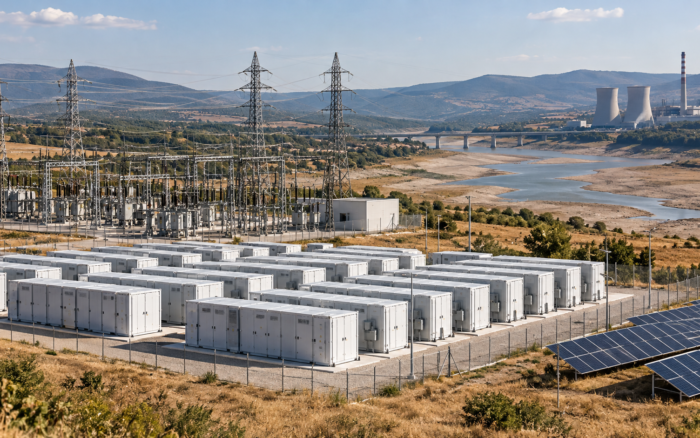
Battery energy storage is no longer invisible in Bulgaria’s electricity statistics. Battery discharge reached 539,155 MWh between January 1 and June 7, 2026. In the same period of 2025, the figure was only 57,344 MWh.
This is one of the most important signals in the data. It shows that batteries are beginning to operate as a meaningful part of the power system, not only as installed capacity on paper.
The timing is important. Bulgaria is adding solar capacity quickly. As solar grows, the system needs assets that can absorb electricity during high-production hours and release it when demand is stronger or prices are higher.
Battery discharge data gives an early view of that shift in practice. For the market, this changes several things. It can reduce curtailment pressure. It can support intraday balancing. It can change price spreads. It can also make renewable power more useful for large consumers looking for cleaner and more predictable electricity supply.
For data centres, industrial users and power-intensive businesses, this is particularly relevant. Storage-backed renewable supply could become a much more important part of procurement strategies, especially in a market where demand is rising and price volatility may increase.
The Export Surplus Is Still Positive, but the Trend Is Important
Bulgaria’s positive export-import balance remains an important feature of the data. But the size of that surplus has changed sharply. A surplus of 341,043 MWh by June 7, 2026 is still positive. Yet compared with 905,878 MWh a year earlier, it shows a much tighter position.
This does not mean Bulgaria is losing its export role. It means the balance is becoming more sensitive. A country can produce more electricity and still have less available for export if domestic consumption grows faster. That is exactly what the latest figures suggest.
For regional markets, this matters because Bulgaria is part of the wider Southeast European electricity picture. Changes in its export availability can affect cross-border flows, price formation and supply expectations in neighbouring markets.
For investors, the narrowing surplus also highlights the importance of local demand. A stronger domestic consumption base can support new generation and storage projects, but it also requires more resilient infrastructure.
Why This Matters for Power Loop Readers?
The latest ESO data shows that Bulgaria’s power system is not simply becoming greener. It is becoming more complex. The country produced 3.45% more electricity by June 7, 2026, but consumed 6.86% more. Baseload generation fell by 10.50%. Renewables grew by 13.45% in the transmission network and by 4.86% in the distribution network. Hydropower rose by 105.44%. Battery discharge increased from 57,344 MWh to 539,155 MWh.
Taken together, these numbers show a market moving away from a traditional baseload-centred structure and toward a more flexible, more variable and more demand-sensitive model.
That transition creates opportunities. More renewables and more storage can support decarbonisation, lower emissions intensity and open new space for power market innovation. Bulgaria can become a more attractive market for renewable developers, battery investors and large electricity users looking for cleaner supply options.
But the transition also creates pressure. The grid must handle more variable generation. Market rules must reward flexibility properly. Storage assets must move from fast deployment to sustainable operation. Large consumers will need smarter procurement strategies. And policymakers will need to understand that renewable growth alone is not enough without balancing capacity, grid investment and demand-side management.
For Power Loop readers, the key takeaway is this: Bulgaria’s electricity system is entering the next stage of the energy transition. The first stage was adding renewable capacity. The next stage is making that capacity work inside a faster, tighter and more complex power market. The June 7 data shows that this shift is already underway.
Sources:
- 3e-news: report based on operational data from Bulgaria’s Electricity System Operator for the period January 1 to June 7, 2026. Used for the figures on electricity production, consumption, export-import balance, baseload generation, renewable energy in the transmission and distribution networks, hydropower and battery discharge.
- SeeNews: additional market context from subsequent ESO data for the period January 1 to June 14, 2026, confirming the continuing trend of higher production, higher consumption, stronger renewable output and a lower trade surplus.
- Renewables Now: regional context on Bulgaria’s grid modernisation, renewable energy expansion, storage growth and transmission capacity challenges.