The European Commission has proposed a common rating scheme that would make the energy and water efficiency of data centers across the EU easier to compare. The delegated act, adopted by the Commission on 21 September, is subject to scrutiny by the European Parliament and the Council before entering into force.
The initiative comes as the sector’s electricity demand grows. EU data centers consumed an estimated68 TWh in 2024, with consumption projected to reach114 TWh by 2030. For developers and investors, the proposed label brings greater visibility to the operating characteristics behind that expansion.
What the EU Rating Scheme Would Change
A reporting framework introduced in 2024 already requires operators with installed information technology power demand of at least500 kW to submit performance information to the European database. The new scheme would turn reported data into electronic labels, giving customers and other stakeholders a common format for assessing individual facilities.
The distinction matters for procurement. A standardized label could make initial comparisons more accessible, while the underlying measurements remain important when evaluating a particular service or investment. Buyers would have a clearer starting point for asking how a facility performs and which operating conditions its rating reflects.
Minimum performance standards are being developed through a separate process. The rating scheme provides a framework for displaying performance; the consultation on future standards considers the levels that facilities may eventually be required to meet.
How Energy and Water Efficiency Would Be Rated
Power Usage Effectiveness, orPUE, compares total facility energy consumption with the energy consumed by IT equipment. A PUE of 1.30 means that, for every 100 units of energy used by IT equipment, the whole facility uses 130. Under the proposed bands, that value would fall in class C.
Water Usage Effectiveness, orWUE, relates freshwater input to IT energy consumption. The scheme would assign separate PUE and WUE grades.The bands are reproduced as published in the proposed scheme. PUE and WUE receive independent grades.
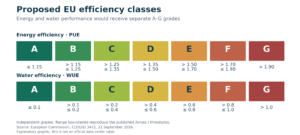
The label would also describe energy sourcing, including renewable and nuclear energy, whether the facility offers flexibility to the grid, and whether it is ready to supply waste heat for external use. These details broaden the assessment beyond the two efficiency grades.
Why Local Conditions Matter
Climate, water stress and facility occupancy affect how the ratings should be interpreted. For a buyer, this means examining the operating conditions behind the rating. A cooling strategy in an area with recurring supply constraints warrants a different discussion from the same design where supply is dependable. Annual averages should be considered alongside the conditions in which the facility must maintain service.
PUE also has a defined scope: it measures facility energy use relative to IT consumption. Assessing the useful computing delivered by that IT equipment requires further information. This distinction leaves investors and customers with two related questions: how efficiently the building operates and how effectively the intended workload uses its resources.
What This Means for Data Center Development
At Power Loop, we see the proposed label as a useful addition to project assessment. Its commercial value will depend on how well investors connect the published grades with the infrastructure available at a location and the demands of the planned development.
For a project in Central or Eastern Europe,power availability and the grid connection schedule remain fundamental. Efficiency assumptions should be tested against the proposed cooling system, expected IT load and development phases. A site assessment can then establish whether the design has a credible route to the performance it intends to achieve.
Water planning belongs in the same early discussion. Developers should examine the supply available to the project, the permissions it requires and how the cooling strategy would operate through seasonal changes. Those findings can influence equipment choices and the capacity that can be developed.
Heat recovery adds another location-specific question. The scheme distinguishes readiness to supply waste heat from actual reuse. Investors should therefore establish whether potential heat customers and the necessary network exist, and what further investment would be needed to connect them.
Grid flexibility also needs an operating plan. The capacity a facility can make available to the electricity system must be considered alongside its service commitments. In our assessment, these practical relationships give the rating its value: they connect measured efficiency with how a development can function within its local energy system.
What Happens Next
The act is subject to atwo-month scrutiny period during which the European Parliament or the Council can object. Its text provides for entry into force 20 days after publication in the Official Journal.
The proposed timetable calls for the first labels to be generated by15 August 2027 and the first review by31 December 2028. Separately, the consultation on minimum performance standards closes on14 December 2026, with a legislative proposal planned for the second quarter of 2027.
Frequently Asked Questions
Who is responsible for reporting in a colocation data center?
The reporting duty sits with the data center operator, although customer-controlled IT equipment can make data collection more complex. Operators may establish internal reporting arrangements with customers. For customers negotiating a contract, it is useful to clarify which measurements they must provide and how their data will be handled.
How should investors assess efficiency claims for a facility still under development?
The proposed scheme would allow facilities that have not opened to participate voluntarily using expected performance after two calendar years of operation. Investors should identify the design assumptions behind those values and request a plan for replacing projections with measured operating data once the facility opens.
What evidence can support the reliability of reported performance data?
Buyers should examine the measurement boundary, meter coverage, calculation method and validation of the reporting process. The proposed changes distinguish self-certification from third-party certification. Establish what has been checked and by whom before relying on a value.
How can customers use efficiency information when selecting a provider?
Customers can use the grades to identify facilities for closer assessment, then discuss their intended workload, service requirements and contract terms. Requests for information should connect the facility’s performance with the service being purchased, including how any efficiency commitments will be measured and communicated during the contract.
Sources of Information
- European Commission, Delegated Regulation C(2026) 3472 and Annexes I–III, 21 September 2026.
- European Commission, Questions and Answers on the Data Centre Energy Efficiency Package, 21 September 2026.
- European Commission, announcement on the rating scheme and implementation process, September 2026.
- Commission Delegated Regulation (EU) 2024/1364, reporting framework and calculation methodology.
- European Commission, Energy Performance of Data Centres and consultation on minimum performance standards.
- Data Center Dynamics, report on the proposed disclosure and rating rules, 22 September 2026.