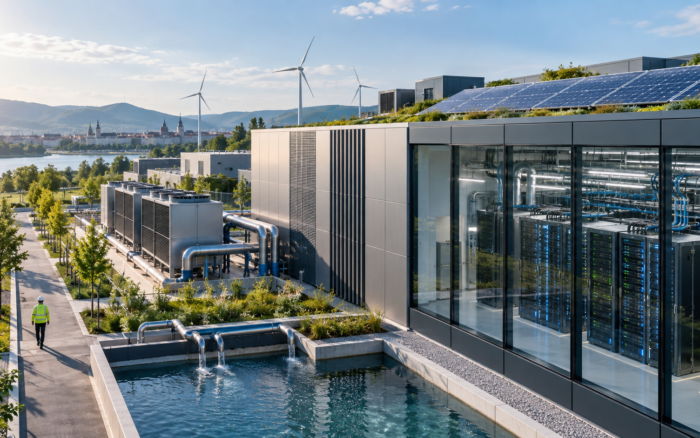
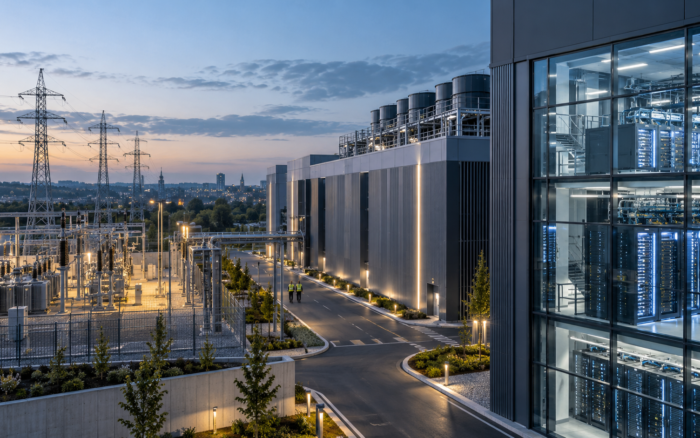
Europe’s data center investment map is beginning to follow the power grid more closely than the traditional real estate map. A well-positioned parcel near Frankfurt, London, Amsterdam, Paris or Dublin still carries strategic weight, but location alone cannot energize a campus, shorten a connection queue or make a high-density cooling design viable. This change sits at the heart of the data center industry trends investors need to understand in 2026: the strongest projects bring land, power, planning and a clearly defined workload into the same development timetable.
At Power Loop, we see this alignment becoming the dividing line between an attractive concept and an investable asset. Cloud computing, cloud services, digital transformation and artificial intelligence continue to expand the digital economy, yet demand is only the beginning of the investment case. The harder question is whether new capacity can be delivered where European customers need it, at a cost the project can support and within a timeframe that still makes commercial sense.
Why 2026 Data Center Trends Are Reshaping Europe’s Digital Economy
Global data centre electricity consumption could approach 950 TWh by 2030, almost twice its 2025 level, while demand from AI-focused facilities is expected to more than triple. Across the three global regions commonly followed by industry leaders: the Americas, EMEA and Asia-Pacific Europe stands out for the interaction between mature digital demand, ambitious decarbonisation policy and an electricity system that cannot be expanded overnight.
Grid connection waits in parts of Europe can extend from two to ten years and average seven to ten years in several FLAP-D markets. A facility, by comparison, may be constructed in one or two. This difference explains why the leading data center trends in 2026 concern execution as much as growth: digital demand can grow faster than grids, permitting systems, supply chains and skilled trades can respond.
| European investment trend | What is changing | The question to ask |
|---|---|---|
| Power certainty | Deliverable megawatts carry more weight than acreage alone. | Can capacity arrive on the stated date and terms? |
| AI workload divergence | Training, inference and cloud services require different locations and designs. | Does the site match the workload behind demand? |
| Energy-led development | Grid impact, efficiency and community expectations affect delivery. | What could alter capex, operating costs or timing? |
1. Power Availability, Construction Costs and Competitive Advantage in Data Center Development
Power availability has become the defining constraint in European data center development because the building programme and the electricity programme now move at different speeds. A parcel may have industrial zoning, fiber access and sufficient scale, yet remain commercially stranded if its grid connection depends on reinforcement works that have no funded schedule.
This mismatch is repricing data center land. In FLAP-D, powered-site values rose by approximately 82% between 2021 and 2026, from around EUR 1.24 million to EUR 2.26 million per MW. The figures belong to Europe’s most constrained primary markets, but the underlying principle reaches beyond them: investors are paying for credible time to power rather than proximity to electrical infrastructure.
Construction costs intensify the risk. Average global costs increased from roughly USD 7.7 million per MW in 2020 to USD 10.7 million in 2025, with another rise expected in 2026. European projects also contend with limited contractor availability, long equipment lead times and designs that must accommodate higher rack densities. Liquid-cooled facilities can cost materially more than comparable air-cooled developments, particularly where local supply chains have limited experience with the technology.
The response is already visible in Europe’s geographical distribution. Greenfield sites account for a much larger share of the current development pipeline than they did five years ago, while hyperscale projects are being planned farther from established hubs. This does not mean that primary markets are losing their importance. It means that future growth will be distributed between mature locations, which retain connectivity and customer density, and emerging markets able to offer power, land and a dependable route through planning.
Why a Powered Land Opportunity Depends on More Than Grid Connection
At Power Loop, we use powered land to describe a documented development position, not a convenient marketing label. A powered land opportunity should establish how much capacity can be supplied, when it can be energized, what reinforcement is required and who carries the cost. It should also show whether the allocation is firm or interruptible and how demand can be phased as tenants take space.
Investor due diligence should verify the connection milestones, required deposits and agreed energization timetable, together with the site’s land rights, zoning position, permits, easements and right-of-way access. The assessment should also cover fiber diversity, communications routes, security requirements, environmental checks, water strategy and cooling needs, as well as the availability of transformers, switchgear and other long-lead supply chain items. Expansion rights, tenant demand and the operator’s delivery capability should complete the review.
For organizations considering self building, procurement and commissioning risk remain on the owner’s balance sheet. A cheaper site can become an expensive delay, whereas a smaller parcel with evidenced power, permissions and expansion rights may offer the stronger risk-adjusted investment. In a capacity-constrained market, preparation becomes a source of competitive advantage.
Power Usage Effectiveness Is Essential, but No Longer Sufficient
Power usage effectiveness remains an essential measure of how efficiently facility energy supports IT equipment, but PUE cannot describe the entire operating profile. Modern data centres must also account for water consumption, carbon intensity, equipment utilization, heat reuse and local grid impact. An attractive annual PUE may still conceal peak power consumption or a cooling strategy that places pressure on local resources.
AI is increasingly used in operations for predictive maintenance, cooling optimization and workload scheduling. These tools can reduce waste and help ensure resilience, although their value depends on the quality of the underlying engineering. Investors should test efficiency claims against climate, expected rack density, energy prices and the facility’s actual operating model.
2. AI Infrastructure and AI Demand Are Changing the European Data Centre Market
AI demand is reshaping the data centre market at both equipment and site level. AI server power density increased eleven-fold between 2020 and 2025 and could rise another four-fold by 2027. Traditional racks commonly operate at around 8–12 kW, while AI clusters can reach 30–80 kW. At those densities, electrical distribution, cooling, floor loading and redundancy are no longer secondary design questions; they determine whether the building can support the intended commercial use.
AI infrastructure concentrates GPUs, accelerators, memory and high-speed networking in ways that conventional cloud facilities were not always designed to accommodate. Air cooling remains suitable for many workloads, but becomes less effective as rack density rises, making direct liquid cooling increasingly important for AI driven workloads. The appropriate solution depends on the tenant, deployment schedule, climate, power profile and capacity required during each phase.
Europe adds a distinctive location dynamic. Large training clusters can follow abundant energy, available land and expansion potential into the Nordics, Iberia and selected CEE markets because much of their work can tolerate greater distance from end users. Inference is more sensitive to low latency, dense communications, data sovereignty and proximity to major population centres, which protects the role of established hubs and national capitals.
For investors, “AI-ready” should invite a technical conversation rather than immediate confidence. Which workload supports the demand forecast? What density can the systems sustain? Which cooling technology is required when the first tenant arrives? Can the design adapt as emerging technologies change, or does every alteration require new capital?
The challenge is not simply how to power AI, but how to avoid paying today for technical capacity that no customer will use tomorrow. Europe is unlikely to develop around a single Silicon Valley-style cluster; its AI economy will be spread across energy-rich training locations and latency-sensitive metropolitan nodes. Successful location decisions will reflect that division instead of treating all AI adoption as one infrastructure requirement.
3. Energy Strategy Is Reshaping the Global Data Centre
Across Europe, the data center is evolving from a large electricity consumer into an energy-intensive infrastructure platform. Grid access remains the foundation, but power purchase agreements, renewable energy sources, storage, demand response, on-site energy generation and microgrids now enter the development strategy much earlier. Operators need to understand not only whether a facility can connect, but how it can operate reliably through the next five years and beyond.
Natural Gas, Renewable Energy Sources and On-Site Energy Generation
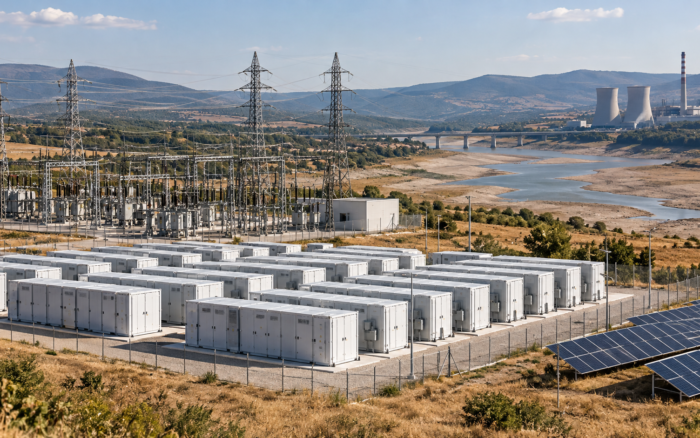
Each energy option solves a different part of the problem. Power purchase agreements can support renewable procurement and improve price visibility, but a financial contract cannot create physical network capacity at a constrained location. Batteries can smooth peaks and provide short-duration resilience, although they do not replace continuous supply. Natural gas generation may offer backup or temporary bridge power in selected European markets, yet it also introduces fuel-price exposure, emissions, air-quality requirements and additional permitting risk.
The strongest strategies combine grid capacity, procurement and flexibility without presenting any single technology as energy independence. On-site systems may reduce reliance on constrained networks at critical times, while renewable energy sources can improve the long-term emissions profile. Their contribution must still be modelled against real operating loads, connection agreements, local regulation and the wider European energy sector.
European Regulation Is Moving Into the Investment Model
EU reporting rules already cover facilities with installed IT power demand of at least 500 kW, bringing energy use, water, temperature settings and renewable consumption into a more consistent framework. An efficiency rating scheme and minimum performance standards are also being developed. These requirements will influence design, operations and the information future buyers expect during due diligence.
The proposed Cloud and AI Development Act adds another dimension. Presented in June 2026, it seeks to accelerate permitting and improve access to energy, land, water and finance while supporting an ambition to triple EU data centre capacity within five to seven years. It is still a proposal rather than a current legal obligation, but its direction is relevant to location strategy and future development activity.
Community acceptance has become equally important. Permitting can take several years, and local groups may oppose data center projects over grid costs, water use, noise, emissions or limited long-term employment. Environmental checks, transparent resource data and early engagement belong at the beginning of development. A technically viable project can still lose time and value if it has not earned permission to operate in practice.
What These Data Center Trends Mean for CEE
Central and Eastern Europe is less saturated than FLAP-D, but lower saturation does not automatically make every country a leading destination. Installed IT capacity across CEE could rise from about 690 MW in 2024 to approximately 1,510 MW in 2031, with Poland and Romania expected to lead much of that growth. Bulgaria begins from a smaller base, creating a selective powered land opportunity rather than an automatic volume proposition.
The region’s case rests on practical fundamentals. New capacity needs secure power, diverse fiber, predictable permits and supply chains capable of supporting complex construction. It also needs experienced operators, educational institutions and skilled trades that can maintain operations after commissioning. Research capability, cybersecurity, political stability and customer access matter alongside land and labor costs.
CEE is well placed to absorb part of Europe’s geographical expansion, particularly where AI training, cloud services and regional data requirements can be served outside the most constrained primary markets. Capacity cannot grow faster than the infrastructure supporting it, however, and low costs will not compensate for uncertain power or a weak delivery team. The projects that lead will be those able to demonstrate how land, energy, connectivity and planning work together.
Frequently Asked Questions
What Are the Most Important Data Center Industry Trends in Europe in 2026?
The three leading data center industry trends are the premium on deliverable power, the divergence between AI training and inference requirements, and the integration of energy performance, regulation and community impact into underwriting. Together, they determine which announced projects can become operating assets.
Why Is Powered Land Valuable to European Investors?
Powered land can clarify a project’s critical path when capacity, connection timing, permits, fiber and expansion rights are supported by evidence. Its value depends on what is technically and contractually deliverable, rather than on a nearby power line or an untested position in a connection queue.
How Is Artificial Intelligence Changing European Site Selection?
AI training favors large power blocks, expansion room and high-density cooling, while inference is generally more sensitive to low latency, network ecosystems and user proximity. Europe therefore needs both energy-rich regional campuses and facilities close to its principal business and population centres.
Can Renewable Energy Sources Solve Europe’s Data Center Power Constraints?
Renewables can lower carbon exposure and support long-term procurement, but variable energy generation, transmission limits and grid queues still require separate solutions. A credible plan combines physical capacity, procurement, storage, flexibility and operational resilience.
What Should Investors Verify Before Acquiring Data Center Land?
Investors should verify connection status, energization timing, reinforcement obligations, firmness of supply, permits, environmental constraints, fiber, water, cooling, equipment lead times, construction costs and expansion rights. Every material assumption should have a document, a responsible counterparty and a date attached to it.
Investment Value Will Follow European Execution
Europe’s data centre industry is growing rapidly, but growth alone does not make a project investable. Power must be deliverable, infrastructure must suit expected demand, and the asset must retain permission to operate as technical and regulatory expectations develop. Over the coming years, value will follow projects that turn energy access, flexible design and disciplined data center development into certainty.
Power Loop evaluates opportunities at that intersection. By connecting land, power, planning and market demand, we help investors distinguish a credible European development platform from an attractive but incomplete map pin. If you are assessing data center land or a powered land opportunity in CEE, speak with our team before capital is committed.