30 September 2026
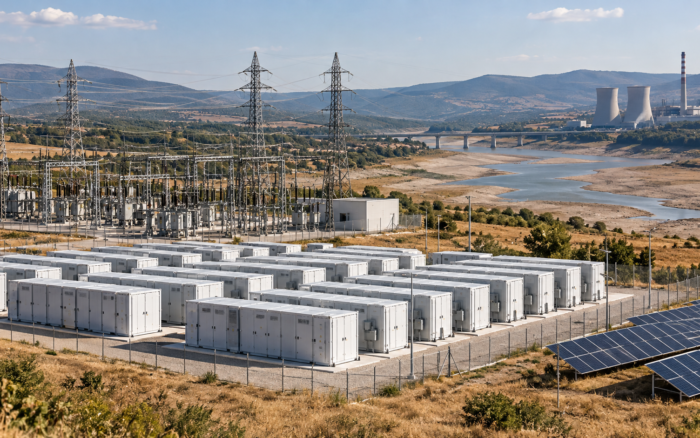
Bulgaria’s rapid expansion of battery storage is drawing attention after a summer in which low river levels put pressure on electricity generation across Eastern Europe. The country recorded net electricity exports of around 830 GWh a month in July and August, more than twice the average for May and June, as demand for imports increased in neighboring markets.
Government figures released on 16 September put the battery power introduced in Bulgaria over the preceding year and a half at around 6 GW. That scale of deployment gives infrastructure investors a concrete case to examine: storage can help move electricity into the hours when it is needed, provided the surrounding network can carry it.
Drought Tests Regional Power Supplies
The pressure was visible within Bulgaria itself. On 14 September, Kozloduy nuclear power plant’s fifth unit was scheduled to reduce output by around 60 MW as a precaution against persistently low Danube levels. The sixth unit continued operating according to its generation schedule. The measures show how river conditions can constrain the operation of major generating assets.
Battery energy storage systems, or BESS, provide flexibility over a different timescale. They charge when electricity is available and discharge later. In a system with substantial solar generation, this allows some daytime production to be used after solar output falls. The benefit comes from changing the timing of supply, while generators and imports remain necessary to replenish stored energy.
The export increase therefore describes the performance of the wider electricity system. Quantifying how much of it came from batteries would require separate charging, discharging and cross-border flow data.
Financing and Existing Grid Access Support Deployment
The growth of battery storage in Bulgaria has been supported by public investment alongside commercial opportunities. On 17 April, official information described 81 projects being implemented under the RESTORE investment, with a combined value exceeding €600 million and nearly 9,750 MWh of storage capacity being built. Those figures describe projects in implementation at that date.
National indicators and project status
| Indicator | Reported value | Period and status |
|---|---|---|
| Battery power introduced over 18 months | Around 6 GW | Official estimate, 16 September 2026 |
| Net electricity exports | Around 830 GWh per month | Reported estimate, July and August 2026 |
| RESTORE projects | 81 | In implementation, 17 April 2026 |
| RESTORE energy capacity | Nearly 9,750 MWh | Capacity being built, 17 April 2026 |
Project status matters when assessing the scale of the transition. A financing decision establishes support for development; confirmation of commercial operation establishes that an installation can participate in the electricity market. These stages can fall months apart.
At Maritsa East 3, a 202 MW installation with 500 MWh of storage was inaugurated in January 2026 and entered the day-ahead and intraday markets. Built within the power station boundary, it uses existing grid infrastructure. The location illustrates the practical value of an established connection when developing a new energy asset.
What the Operating Projects Show
Power and energy capacity answer different questions. Megawatts measure the rate at which a system can deliver electricity. Megawatt-hours measure the amount it can store. Dividing the published energy capacity by rated power gives an indicative duration at full output.
Two operational Bulgarian battery installations
| Installation | Rated power | Energy capacity | Nominal duration |
|---|---|---|---|
| Maritsa East 3 | 202 MW | 500 MWh | 2.48 hours |
| Nova Zagora | 150 MW | 601.8 MWh | 4.01 hours |
Nominal duration is calculated as published MWh ÷ MW, rounded to two decimal places. It is indicative: usable energy, state of charge and operating limits affect delivery. The two installations are selected examples, not a national total.
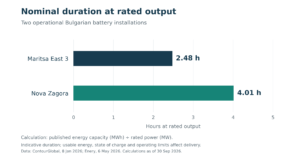
Nova Zagora began operating in March 2026. Its published specifications imply roughly four hours at rated output, compared with about two and a half hours at Maritsa East 3. The comparison shows why a larger MW figure alone does not establish how long an installation can sustain delivery. The energy available behind that power rating is equally important.
More Storage Changes the Commercial Calculation
These operating windows make batteries useful for balancing supply over the day and responding to short disruptions. Covering a prolonged reduction in generation requires continued access to electricity for recharging. Transmission capacity also determines how far the stored energy can support consumers across national borders.
A growing battery fleet can also change the economics that encouraged investment. As more systems charge during cheaper periods and discharge during expensive ones, the price gap can narrow. For a project earning revenue from that spread, future returns depend on how the market develops, alongside efficiency, cycling costs and access to other eligible services.
The next phase therefore calls for investment in the network as well as storage. Batteries can improve grid flexibility, while transmission and distribution upgrades determine where that flexibility can be used and which additional loads can connect.
Why This Matters for Power Loop Readers?
For data center developers, Bulgaria’s experience makes the local electricity network a central part of site assessment. A European energy assessment published in November 2025 identified grid connection waiting times of two to ten years across the EU, depending on the country. It also noted that a data center typically takes one to two years to build.
We see the Bulgarian expansion as a reason to examine how storage, generation and grid access work together at individual locations. National deployment figures provide context; a proposed development still needs a documented connection schedule and clear conditions for the capacity it will draw.
The role of any battery must also be defined. A facility trading electricity into the national market and a system reserved for a data center’s backup duties have different operating commitments. For an investment decision, the useful evidence is the power available to the site, its permitted operating conditions and the infrastructure that will sustain the intended workload.
Frequently Asked Questions
Does adding storage automatically reduce electricity emissions?
The emissions effect depends on the electricity used for charging and the generation displaced when the battery discharges. Charging from a grid with substantial fossil generation can produce a different outcome from storing otherwise unused renewable electricity. A credible assessment should examine the charging schedule and energy losses, alongside the local generation mix.
What Affects the Lifespan of a Battery System?
Battery cells age both with time and through use. Temperature, charging rates and the depth of each discharge influence how quickly usable capacity declines. Investors should examine the warranty’s operating assumptions and retained-capacity commitments, then allow for maintenance or battery replacement in the project model.
What does round trip efficiency tell an operator?
Round trip efficiency compares the electricity recovered during discharge with the electricity consumed during charging. It helps quantify energy losses and charging costs. Comparisons should use the same measurement boundary, since a figure for battery cells alone may exclude losses in power conversion equipment and the energy consumed by auxiliary systems.
Can any grid connected battery provide balancing services?
Access depends on qualification for the particular service. In Bulgaria, prospective providers must meet the system operator’s technical requirements and pass the relevant prequalification process. A project assessment should establish which services the installation can offer and the contractual conditions under which its capacity will be made available.
Sources of Information:
- Euronews / AFP, battery storage and regional electricity trade, September 2026.
- Bulgarian Ministry of Energy, RESTORE and battery capacity updates, April and September 2026.
- ContourGlobal, Maritsa East 3 commissioning announcement, January 2026.
- Enery, Nova Zagora technical specifications, May 2026.
- IEA, battery storage report (2024) and European data center energy analysis (2025).
- NLR / NREL, research on battery lifespan, storage efficiency and emissions.
- ESO, balancing service technical requirements and prequalification.