For two decades, Europe’s data center map had one center of gravity: Frankfurt, London, Amsterdam, Paris, and later Dublin. That map is being redrawn. Grid queues, land scarcity, and connection restrictions in the established hubs are pushing developers to ask a question that would have sounded eccentric ten years ago: what about Central and Eastern Europe? This piece is for the people who have to answer it: investors, developers, operators, and energy infrastructure stakeholders. CEE is not automatically cheaper or easier, but the logic of site selection has shifted in its favor. The map of European data center locations is no longer drawn around capital cities alone. It is drawn around power, land, connectivity, compliance, and room to grow.
Why Central & Eastern Europe Is Moving Into the Data Center Conversation?
The demand side is not in dispute. The International Energy Agency expects global electricity use by data centers to roughly double between 2024 and 2030, to around 945 terawatt hours, with AI as the largest driver. Europe needs a meaningful share of that capacity built inside its own borders, partly for latency and data sovereignty, partly because cloud services follow their users.
The supply side is where CEE enters. Ireland’s grid operator restricted new connections around Dublin. A data center still has to go somewhere, and developers have started looking east, where land is available, grids are being modernized, and demand from Warsaw to Bucharest is growing fast. None of that makes the region a default answer. It makes it a serious candidate when the site conditions line up.
Data Center Land: Why Site Readiness Matters More Than Raw Acreage
CEE’s most advertised advantage, space, is also its most misunderstood. Hectares are cheap across the region. Hectares that can actually host a facility are not. A parcel qualifies as data center land only when it comes with a realistic power path, fiber routes within reach, physical security, and enough adjacent space for a second phase.
Rural sites illustrate the trap. The land is wide open and inexpensive, but the nearest substation may be small, the distribution lines old, and high-speed internet a promise rather than a cable. Buy on acreage, and you own a field. Buy on proximity to substations, transmission, and fiber, and you own the start of an infrastructure asset.
Powered Land and the New Logic of Data Center Development
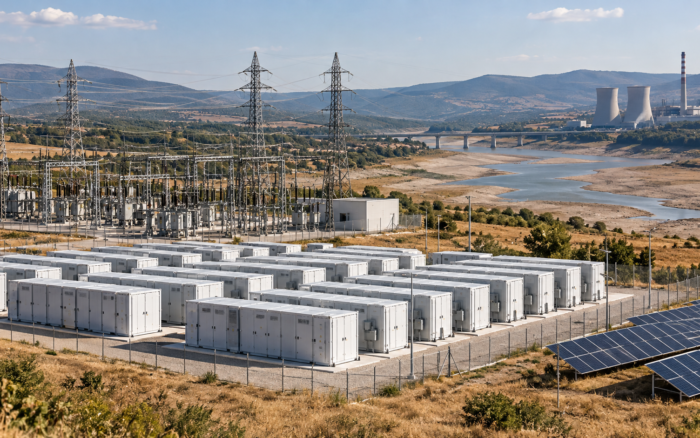
The regional version of a global truth: powered land is becoming its own asset class. The term means land with a credible, documented path to sufficient power capacity, not land that happens to sit near an electrical line. Credible means the grid operator has confirmed capacity and a connection timeline, power rates are understood, and there is room for backup systems or on-site generation where the workload demands high availability and uninterrupted operations.
A cheaper site with uncertain power can become more expensive than a higher-priced site with a credible path to energization, once financing carry and lost revenue enter the calculation. For critical workloads, the connection date is the business case.
What Makes a Good Data Center Location in CEE?
So what makes a good data center location in this region? Power availability comes first, and everything else follows in order of veto power. Fiber connectivity with genuine route diversity. Latency low enough for the target end users. Low exposure to natural disasters, since much of CEE sits outside major seismic zones, though local flood plains and extreme weather events still need checking. Access to emergency services. Cooling resources that match the intended density. A local government that answers permitting questions in weeks, not quarters. Skilled labor within commuting range. And honest math on total cost, because a bargain that fails two of these tests is not a bargain.
How to Choose Data Center Location: The Site Selection Process
Most advice on how to choose data center location stops at a checklist. The sequence matters more. Start by defining the workload: cloud services, AI training, edge, colocation, or enterprise systems; each carries different power, latency, and redundancy needs. From the workload, derive power consumption today and energy demand five years out. Only then approach the grid: verify capacity and get the connection timeline in writing.
Fiber comes next, with multiple providers rather than one. Then climate, since cooling efficiency and the choice of cooling systems flow from it. Then physical security and data security requirements, followed by the regulatory layer: local rules, data sovereignty, and the practical work of ensuring compliance. Price the whole thing: electricity, cooling costs, taxes, land, construction, operations. Check expansion capacity. Close by modeling what can go wrong: power outages, extreme weather, water shortages, supply chain delays. Ten steps, and skipping one usually costs more than doing it.
Best Data Center Locations Are Built Around Power, Connectivity and Risk
The old logic ranked sites by land cost, distance to a major city, and basic connectivity. The new logic ranks them by power availability, grid resilience, energy efficiency, compliance, latency, renewable energy potential, and environmental impact. Northern Virginia shows why the old logic broke: the world’s largest data center market now wrestles with multi-year connection queues, land pressure, and community pushback that scale itself created.
The best data center locations over the next decade will be the ones that never have to choose between power and permission. CEE cannot claim that status by default. Individual sites in the region can earn it.
Lower Operational Costs Can Strengthen the Business Case
Cost is where CEE pitches usually start, so a caution first: the region is not uniformly cheap. Electricity costs, labor, taxation, and permitting vary sharply between countries, and grid constraints can erase a headline price advantage. What the region does offer, selectively, is lower operational costs on land, construction, and staffing than the saturated Western hubs, plus tax incentives or local government support in markets competing for projects. The honest framing is total cost of ownership over fifteen years, including the value of capacity that can generate revenue sooner because the connection arrived on schedule. On that math, several CEE markets compete well. On a naive price-per-hectare comparison, the numbers flatter and mislead.
Energy Efficiency and Cooling Conditions Support Long-Term Operations
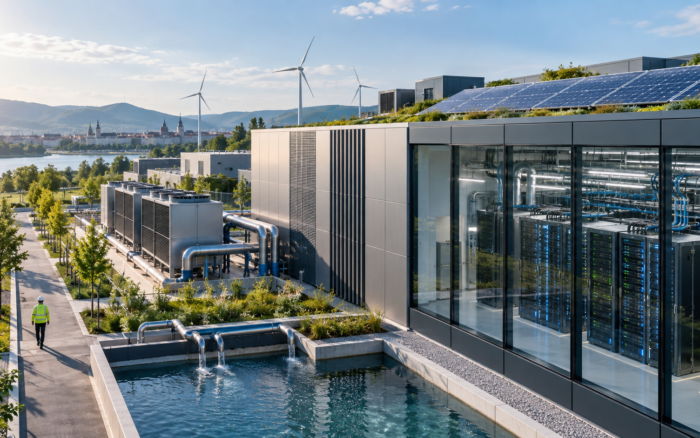
Climate quietly favors parts of the region. Cooler ambient temperatures across much of CEE extend the free-cooling window, which means less energy spent on cooling and better power usage numbers, while evaporative cooling remains an option where water resources permit. Renewable energy build-out across the region means cleaner supply and lower carbon exposure, and extensive district heating networks in some countries create an opportunity to sell waste heat instead of venting it. [Internal link: renewable energy and battery storage]
The caveat repeats from earlier: cooling strategy is land strategy. A site with abundant land but poor water resilience or high environmental risk will age badly, whatever its energy use looks like on day one.
Data Security, Data Sovereignty and Ensuring Compliance
For many companies, location is a legal decision before it is an engineering one. CEE markets inside the EU offer the full regulatory package: GDPR alignment, data sovereignty within the single market, and a predictable framework for critical workloads. The obligations are real too. The revised Energy Efficiency Directive requires data centers with at least 500 kW of installed IT power to report energy performance, water use, heat reuse, and renewable share annually to a European database.
Physical security, a secure environment for tenant equipment, tested backup systems, and demonstrable high availability round out the picture. Compliance built into the design costs less than compliance retrofitted after an audit.
Edge Data Centers and Proximity to End Users
Not everything in the region needs to be a hyperscale campus. CEE’s geography, a string of sizable population centers from Prague and Warsaw to Sofia and Bucharest, suits distributed digital infrastructure. Edge data centers placed near those cities cut latency for streaming, payments, and the machine traffic from autonomous vehicles and industrial systems. Regional cloud services, public administration, finance, healthcare, and educational institutions all pull capacity closer to end users. Direct access to national internet exchanges and high-speed internet backbones makes smaller facilities viable where a giant campus would never pencil.
Future Growth: Why CEE May Matter More Over the Next Few Years
The trajectory is visible in the region’s largest market. Poland has grown into the anchor of CEE data center capacity, and development is already spreading beyond Warsaw as grid availability in the capital tightens. Cloud adoption across the region still trails Western Europe, which is another way of saying the demand runway is long. AI workloads, digital economy growth, and local governments hungry for investment, tax revenue, and high-paying jobs all point the same direction.
Whether the region converts the opportunity depends on grid investment, permitting speed, skilled labor, and environmental safeguards. Future growth is a possibility to be built, not a certainty to be banked.
Risks Developers Should Not Ignore
A balanced case names the failure modes. Grid delays and power outages where networks are still being modernized. Water shortages in specific basins. Extreme weather and lightning strikes on long overhead distribution lines. Permitting that moves fast in one municipality and stalls in the next. Community opposition, which arrives in CEE as surely as anywhere. Thin markets for skilled trades. Supply chain delays on transformers and switchgear. Dependence on a single utility connection or a single data center where the workload deserves redundancy. Weak backup systems specified to a budget rather than a risk model. None of these kills the regional case. Each of them has killed individual projects.
Why CEE Can Be a Strong Choice for the Right Data Center Project?
Pull the threads together, and the conclusion is conditional, which is what makes it useful. A data center project in Central and Eastern Europe works when a specific site combines ready land, genuine powered-land characteristics, diverse fiber, competitive power rates, reliable grid access, a permitting authority that engages, defensible physical security, EU data sovereignty, cooling efficiency, and space for future growth. [Internal link: powered shell] Where several of those are missing, the region’s averages will not save the project.
The next phase of data center growth will not be shaped only by the largest global markets. It will be shaped by locations that can deliver power, land, connectivity, efficiency, and regulatory confidence at the same time. For the right project, Central and Eastern Europe deserves serious attention.
Frequently Asked Questions
Why is Central & Eastern Europe attractive for data center development?
Available land, improving digital infrastructure, growing regional demand, EU membership in most markets, and lower operational costs in selected countries. The advantage is conditional: it applies where a site pairs land with confirmed power and connectivity.
What makes a good data center location?
Confirmed power availability, diverse fiber connectivity, low latency to target users, physical security, manageable climate and disaster risk, adequate cooling resources, clear permitting, compliance alignment, and room to expand. Power carries the most veto power; the rest determine cost and speed.
Why is powered land important for a data center project?
Because power availability and grid connection timelines now decide whether projects proceed at all. Land with a documented path to capacity removes the largest single uncertainty from the schedule, which lowers financing risk and often justifies a higher purchase price.
How do data centers affect energy use and environmental impact?
They concentrate electricity demand and, depending on cooling systems, water use. Operators manage the footprint through energy efficiency, renewable supply, water-efficient or free cooling, and waste heat reuse. In the EU, facilities above 500 kW must now report these metrics annually.
How should investors compare data center locations?
On total cost and total risk, not land price. Compare power rates and grid reliability, connection timelines, permitting track record, data sovereignty fit, fiber diversity, proximity to end users, cooling efficiency, and realistic expansion potential over a ten-to fifteen-year horizon.
Sources of information
- International Energy Agency, Energy and AI: https://www.iea.org/reports/energy-and-ai/executive-summary
- International Energy Agency, Key Questions on Energy and AI (2026 update): https://www.iea.org/reports/key-questions-on-energy-and-ai/executive-summary
- European Commission, Energy performance of data centres: https://energy.ec.europa.eu/topics/energy-efficiency/energy-efficiency-targets-directive-and-rules/energy-efficiency-directive/energy-performance-data-centres_en
- European Data Centre Association, Energy Efficiency Directive knowledge hub: https://www.eudca.org/energy-efficiency-directive
- Engineering News-Record, Grid access as the emerging constraint for data center construction: https://www.enr.com/articles/62227-grid-access-not-land-emerges-as-bottleneck-for-data-center-construction