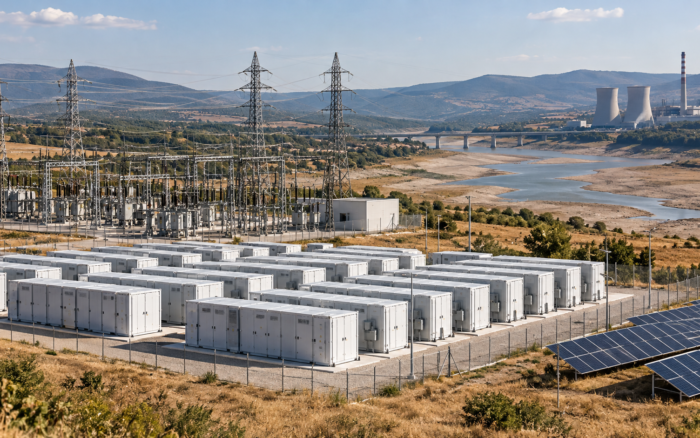
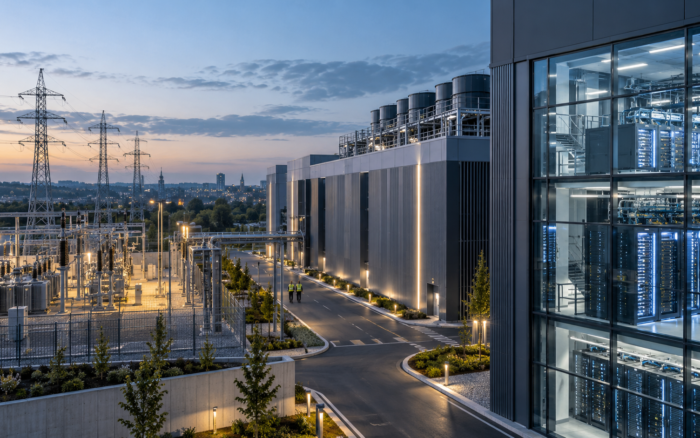
For decades, batteries in data centres had one principal job: to keep servers running during the interval between a grid failure and the start of emergency generation. Their importance was measured by reliability, not by their interaction with the electricity system.
The rapid expansion of AI infrastructure is changing that role. Higher power density, faster variations in computing demand and growing pressure on grid connections have made on-site storage relevant long before an outage occurs. A battery can smooth sudden changes in consumption, reduce the facility’s maximum import and respond when the network is constrained.
This does not make every battery-equipped data centre a grid asset. The outcome depends on how the storage is sized, controlled and coordinated with the computing workload. The difference lies in the design of the complete energy system rather than the presence of battery containers beside the building.
The battery is moving beyond emergency use
Continuity remains the first priority for a data centre. Critical applications cannot be interrupted because wholesale electricity prices have increased or the local network is experiencing a difficult evening peak.
A modern battery system can protect this requirement while performing additional functions. It may respond to voltage fluctuations, smooth rapid load changes and reduce short periods of unusually high grid demand. Subject to local market rules, it may also participate in balancing services or provide demand response.
These functions have become more relevant as AI servers place new demands on electrical infrastructure. According to the International Energy Agency, the power density of AI servers increased elevenfold between 2020 and 2025. A single advanced server rack could have peak power demand equivalent to that of 65 households by 2027.
The challenge is not limited to the amount of electricity consumed during a year. AI training and model operation can also produce sharper and less predictable changes in load. Transformers, switchgear and the grid connection must be able to manage those changes without compromising reliability.
Storage can act as a buffer between a dynamic computing facility and a network that operates within stricter physical limits.
What the analysis of 96 UK data centres found
Researchers from Vienna University of Economics and Business, the International Institute for Applied Systems Analysis and King Abdullah University of Science and Technology examined electricity consumption profiles from 96 data centres connected to the UK Power Networks system.
The team used half-hourly demand data to simulate how on-site batteries with different power ratings and durations would affect the maximum electricity imported from the grid.
Their analysis found that battery storage could typically reduce peak grid import by approximately 10% to 15%. The exact result varied between facilities because their consumption profiles were not identical. Data centres with more pronounced peaks offered greater scope for reduction, while sites operating close to a constant load had less flexibility.
The figure below translates the research result into an index. A value of 100 represents the original peak grid import. The two storage cases show the range identified across the modelling.

| Research indicator | Finding | Practical meaning |
| Data centre profiles analysed | 96 | The calculation is based on real UK consumption profiles rather than a single theoretical facility |
| Measurement interval | 30 minutes | The analysis captures variations in demand across each day |
| Typical peak import reduction | 10–15% | Storage may lower the maximum capacity drawn from the network |
| Expected global data centre battery capacity by 2030 | 20–25 GW | The IEA expects on-site storage to become a material part of data centre energy infrastructure |
For a large facility, a 10% reduction may represent a significant amount of capacity. It could support a phased connection, reduce part of the immediate network requirement or allow more equipment to operate within an existing import limit.
The research does not prove that every project can request a 15% smaller connection. It is a technical assessment, not a complete economic model. Battery cost, degradation, electricity prices, grid tariffs and the commercial value of system services must be considered separately.
Why adding more battery capacity eventually delivers less
Data centres usually operate with a high and relatively stable base load. Storage can remove temporary peaks, but it cannot replace the continuous flow of electricity needed by servers, cooling systems and supporting infrastructure.
Once the short peaks have been reduced, installing a larger battery may produce progressively smaller reductions in maximum import. The facility still needs to meet its underlying demand.
The distinction between battery power and battery duration becomes important here. Power capacity determines how quickly a system can charge or discharge. Energy capacity determines how long it can sustain that output. A high-power battery may respond effectively to a brief load spike but provide limited support during several hours of network constraint.
Its resilience obligations must also be protected. A battery that has been discharged into the electricity market may not have enough stored energy when an outage occurs. Operators need to reserve a sufficient level of charge for emergency use and define which additional services can be provided without weakening the primary function of the system.
| Storage function | Value for the facility | Main limitation |
| Emergency supply | Maintains critical operation during short interruptions | Part of the battery capacity must remain reserved |
| Peak reduction | Limits maximum electricity import | Less effective against a high, continuous base load |
| Load smoothing | Protects electrical equipment from rapid changes | Requires fast controls and accurate operational data |
| Renewable energy shifting | Moves available clean electricity to a later hour | Climate benefit depends on the source used for charging |
| Grid services | Creates a possible additional revenue stream | Market access, metering and contractual rules differ by country |
Storage is most useful when the system is designed around a clearly defined combination of these functions. Attempting to capture every possible revenue stream can increase cycling, accelerate degradation and create conflicts between commercial operation and resilience.
Computing demand can provide a second layer of flexibility
Not every computing task has the same urgency. Online transactions, cloud services and AI inference used by customers may require an immediate response. Other processes can tolerate a delay.
AI model training, large-scale data processing, system testing and some backup activities may be scheduled for a later hour without affecting the end user. They may also be moved between data centres where network capacity and clean electricity are available.
This makes computing demand a potential flexibility resource. The facility does not need to shut down. Its operator can identify which workloads are time-sensitive and which can respond to electricity conditions.
Storage and workload management operate at different speeds. A battery can react within seconds when grid conditions change. Computing tasks can then be reduced, postponed or transferred according to technical and contractual limits.

The distinction between flexible and critical workloads must remain clear. Customer commitments, cybersecurity requirements, data-location rules and network latency may prevent certain processes from being moved. An operating strategy based on unrealistic flexibility assumptions could leave the facility unable to meet either its service obligations or its grid commitments.
Flexible consumption is not automatically low-carbon
Reducing demand during an evening peak can support the network, but the climate effect depends on what happens before and after that reduction.
If a battery charges when coal or gas generation is setting the marginal supply, moving that electricity to another hour does not create clean energy. Similarly, transferring computing activity to another facility is useful only if the destination has available capacity and a more favourable electricity mix.
Hourly carbon data and reliable information about local network conditions are therefore more valuable than annual claims alone. The strongest model combines demand flexibility with additional renewable or other low-carbon generation.
This coordination may also create a market for longer-duration storage. The IEA expects approximately 20–25 GW of battery capacity to be installed at data centres globally by 2030. Large technology companies could help emerging storage technologies reach commercial scale by providing long-term demand and credible contracts.
Grid interaction must be agreed before connection
A data centre cannot promise flexibility informally and expect the grid operator to treat it as dependable capacity. The response must be technically measurable and supported by a clear contract.
A flexible connection may allow the facility to operate within a lower import limit during network stress. In return, the developer may gain earlier or phased access to capacity. The arrangement needs precise rules covering response times, availability, metering and the consequences of non-performance.
The same principle applies to batteries providing balancing services. Ownership, licensing, network tariffs and responsibility for dispatch must be established before the system enters operation.
These questions belong at the site-selection and design stage. The available grid capacity, connection structure, battery location, fire-safety requirements and access to electricity markets can influence both the layout and economics of the project.
Why does this matter to Power Loop readers?
For Power Loop readers, the 10–15% figure is valuable because it changes the discussion about power availability. A grid connection should not be viewed only as a fixed capacity that a project either receives or does not receive. Storage and flexible computing may create more options, including phased energisation, managed import limits and better use of constrained infrastructure.
The opportunity needs to be assessed with discipline. An announced battery capacity does not guarantee a smaller connection requirement, lower electricity costs or access to balancing revenues. Each claim must be tested against the facility’s real load profile and the rules of the local market.
At Power Loop, we see the most credible data centre projects emerging when land, grid access, storage and operational demand are evaluated together. The energy strategy cannot be added after the site has been selected and the connection request submitted.
A battery remains an essential resilience asset. Combined with intelligent workload management and a measurable commitment to the network, it can also help a data centre become a more responsive participant in the power system.
Frequently asked questions
Is there a standard battery size for every megawatt of data centre load?
No fixed ratio works for every facility. Battery sizing starts with the purpose of the system. A project designed for short power-quality events will need a different configuration from one intended to reduce demand peaks or support several hours of operation. Engineers must also consider the real load profile, planned IT expansion, reserved emergency capacity, connection limits and acceptable depth of discharge. Using the requested grid capacity alone can lead to an oversized system, particularly when the data halls will be filled gradually.
Which battery chemistry is best suited to a data centre?
The choice depends on the balance between safety, available space, discharge performance, operating temperature, expected cycling and lifetime cost. Lithium iron phosphate batteries are widely considered for stationary storage because of their cycle life and thermal characteristics, but chemistry should not be evaluated in isolation. The enclosure design, battery management system, cell quality, cooling, testing history and supplier warranty can be equally important. The preferred technology may also change according to the required duration and the amount of space available at the site.
Can battery capacity be expanded as the data centre grows?
A modular system can be installed in stages as additional data halls become operational. This may prevent the developer from paying for the full battery capacity before the corresponding computing load exists. Phased expansion still needs to be planned from the beginning. The site must reserve sufficient space, cable routes, switchgear capacity and control-system capability for future modules. Each stage may also require updated grid studies, fire-safety approval and commissioning tests, depending on local regulations and the agreed connection conditions.
What fire-safety evidence should developers request from a battery supplier?
Developers should examine system-level evidence rather than relying only on the characteristics of individual cells. Relevant documentation may include thermal-runaway propagation testing, gas and heat-release data, detection and suppression strategies and emergency shutdown procedures. UL 9540A provides a recognised method for evaluating how thermal runaway can spread through a battery system. Installation requirements, separation distances, ventilation and emergency planning must also be assessed under the applicable local framework, such as NFPA 855 where relevant.
Can a third party own and operate the on-site battery?
The data centre operator does not necessarily need to own the system. Under a storage-as-a-service arrangement, a specialist company may finance, operate and maintain the battery in return for an availability payment, a share of market revenue or a long-term service fee. The contract must establish which function has priority when several parties want to use the battery at the same time. Emergency readiness, data centre resilience and agreed grid obligations should take precedence over short-term trading opportunities.
Why is cybersecurity important for a grid-interactive battery?
A grid-interactive battery is controlled by software and may exchange information with the data centre, an external operator, electricity markets and the grid. This creates an operational technology environment that requires protection alongside the facility’s conventional IT systems. Network segmentation, restricted remote access, authenticated control commands, event logging and secure software updates should form part of the design. The system must also retain a safe local operating mode if external communications are interrupted. NIST guidance for distributed energy resources treats secure monitoring and control as central requirements for connected energy assets.
How is battery health managed over the lifetime of the project?
Battery capacity gradually declines as a result of age, temperature and the number and depth of charge cycles. Operators monitor state of health, usable capacity, temperature differences and other performance indicators to determine whether the system can still meet its contractual duties. Procurement should examine both the calendar warranty and the permitted energy throughput, as intensive market operation may use the available cycle allowance faster than expected. Developers may reserve space for later augmentation, allowing new modules to restore lost capacity. In the EU, lifecycle planning must also reflect the sustainability, traceability and end-of-life requirements introduced by Regulation (EU) 2023/1542.
Sources of information:
- Zakeri et al., The AI–Energy Storage Nexus: Opportunities for Clean Energy Transitions – Research framework, modelling methodology and the relationship between AI infrastructure and energy storage.
- Vienna University of Economics and Business – Analysis of 96 UK data centres and the potential 10–15% reduction in peak grid import.
- International Institute for Applied Systems Analysis – Practical interpretation of battery storage, computing flexibility and grid connection reform.
- International Energy Agency, Key Questions on Energy and AI – AI server power density and projected battery deployment at data centres.