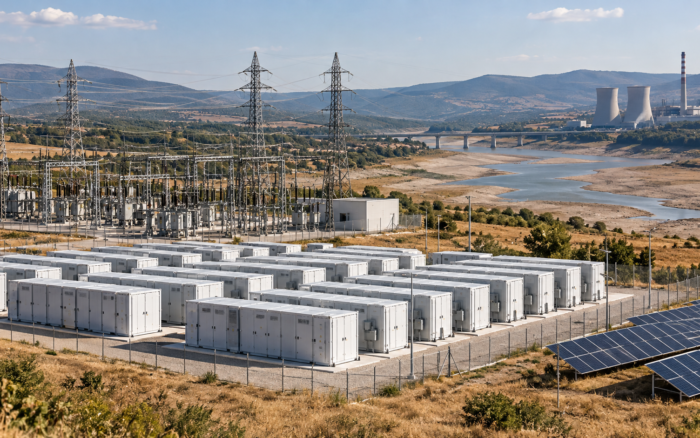
Bulgaria’s electricity system is undergoing one of the fastest transformations in Europe. In less than two years, battery energy storage has moved from the margins of the market to a scale capable of changing national load patterns, electricity flows and price formation across Southeast Europe.
Data published in May 2026 indicate that Bulgaria had approximately 3.32 GW of operational battery storage power and more than 8.6 GWh of energy capacity. An updated reading from the Electricity System Operator placed the figure at around 3.43 GW as of 20 May. Relative to the size of the country’s power system, economy and population, this is an exceptional concentration of storage infrastructure.
The expression “the battery of the Balkans” is therefore more than an attractive headline. Bulgaria can increasingly absorb electricity during low-price hours and release it when regional demand and prices rise. Yet the phrase must be used with technical precision. Batteries do not create energy, nor do they replace the need for reliable generation, strong transmission networks or long-duration reserves. Their role is to move electricity through time and make the system more flexible.
From solar surplus to dispatchable energy
The rapid expansion of solar generation has changed the daily profile of the Bulgarian electricity market. During sunny hours, photovoltaic plants can produce large volumes of electricity at the same time, pushing wholesale prices down and occasionally contributing to zero or negative prices. After sunset, solar production falls quickly while household and commercial demand often remains high.
Battery energy storage systems, or BESS, help bridge this gap. They charge when electricity is abundant and comparatively inexpensive, then discharge during the evening peak. This reduces the need to curtail renewable generation and allows part of the midday solar surplus to remain useful after the sun has set.
From an engineering perspective, this is one of the most valuable functions of storage. A photovoltaic plant without storage supplies electricity according to weather conditions. A solar facility combined with a properly sized battery can deliver a more controlled output profile and respond more effectively to market and system requirements.
The distinction between power and energy capacity is important. Megawatts measure how quickly a battery can charge or discharge, while megawatt-hours show how much electricity it can store. Bulgaria’s reported 3.32 GW and 8.6 GWh correspond to an average discharge duration of roughly two and a half hours at full power.
That is highly relevant for intraday balancing, evening peaks and short-term market volatility. It is not, however, sufficient to cover prolonged periods of low renewable production. Batteries with this duration are flexibility assets, not seasonal energy reserves.
Public support accelerated a market that was already forming
A central driver of the expansion has been the RESTORE programme under Bulgaria’s National Recovery and Resilience Plan. The European Commission describes the investment as support for a national infrastructure of grid-scale electricity storage, backed by €603 million from the Recovery and Resilience Facility. Its original objective was to commission at least 3,000 MWh of usable storage capacity.
Investor interest significantly exceeded that target. The first major RESTORE selection covered more than 9.7 GWh of planned capacity, while subsequent support increased the country’s contracted storage pipeline further. This demonstrates that public funding did more than finance a predetermined volume. It helped unlock private capital at a moment when falling battery costs, expanding solar production and widening intraday price spreads were already improving the commercial case for storage.
The result should still be interpreted carefully. Awarded, contracted and operational capacity are not interchangeable terms. A project that has received support does not contribute to the electricity system until it has been constructed, connected, tested and successfully commissioned. Grid availability, equipment delivery, control integration and compliance with technical requirements remain decisive.
The pace of actual deployment is nevertheless remarkable. Bulgaria had more than 3.3 GW online by May 2026, and several large installations have entered operation within short construction periods. This gives the country an early-mover advantage over neighbouring markets where storage development has progressed more slowly.
A new position in regional electricity trading
Bulgaria is part of an interconnected regional market. Electricity prices in Greece, Romania, Serbia and other neighbouring systems influence domestic trading, while cross-border capacity allows energy to move toward the market where it has the greatest immediate value.
When solar generation is high across the region, Bulgarian batteries can absorb inexpensive domestic or imported electricity. Several hours later, the stored energy can be returned to the Bulgarian market or indirectly support exports when regional prices rise.
This does not mean that electrons stored in one battery are commercially assigned to a particular neighbouring country. The effect occurs through market coupling, price signals and changing cross-border flows. Storage reduces demand while discharging and increases it while charging. At sufficient scale, both actions influence the position of the entire Bulgarian power system.
The regional opportunity is real, but it is not unlimited. Interconnection capacity, internal grid congestion and market rules determine how much value can be transferred across borders. Bulgaria’s future role will therefore depend on transmission investment and regional market integration as much as on the number of installed battery containers.
Storage can solve problems and create new ones
The first wave of battery projects benefits from pronounced differences between low midday prices and higher evening prices. As more systems follow the same signals, however, those differences may narrow. Batteries can raise prices while charging during solar hours and reduce them while discharging in the evening. This is positive for market stability, but it also compresses the arbitrage margin on which many investment models currently rely.
Synchronous operation creates another challenge. If thousands of megawatts of batteries begin charging at nearly the same moment, they can produce a new demand peak instead of simply absorbing surplus generation. The same applies to simultaneous discharging. Storage is controllable, but controllability creates value only when assets are coordinated through accurate forecasts, energy management systems and appropriate market incentives.
For that reason, the long-term business case cannot depend exclusively on buying low and selling high. Competitive projects will increasingly need access to several revenue streams, including intraday trading, balancing services, congestion management and other forms of grid support. Technical availability, degradation management, cybersecurity and dispatch performance will become as important as installed capacity.
The next stage will require system-level thinking
At Power Loop, we see Bulgaria’s storage expansion as a structural shift rather than a temporary investment boom. The country is building the infrastructure needed to convert variable renewable generation into more manageable and market-responsive electricity.
The next step is to ensure that storage develops as part of a coherent power system. Battery location, grid connection strength, duration, control strategy and compatibility with renewable generation must be assessed together. Adding capacity without considering network constraints can simply move congestion from one hour or location to another.
Bulgaria may indeed become the battery of the Balkans, but its lasting advantage will not be measured only in gigawatts or gigawatt-hours. It will depend on how intelligently those assets are integrated, how reliably they respond to system needs and whether the country can combine short-duration batteries with grid reinforcement, flexible demand, pumped-storage hydropower and other longer-duration solutions.
The battery boom has given Bulgaria an early lead. Turning that lead into durable regional influence will require the same qualities expected from a modern power system: coordination, technical discipline and the ability to respond before imbalance becomes instability.
Sources of information:
- European Commission – National infrastructure for storage of electricity (RESTORE)
- Balkan Green Energy News – Bulgaria surges to world’s No. 1 in battery systems share
- Renewables Now – Bulgaria grows into EU energy storage hotspot with over 3.3 GW online
- POWER Magazine – EU’s largest BESS project commissioned in Bulgaria